You know that feeling when something you've always counted on just... isn't there anymore? That's what's happening in our fields and gardens right now. Bees are disappearing, and honestly, it's a lot scarier than most people realize. We're not just talking about less honey. We're talking about the very foundation of our food supply starting to wobble.
Think about your last meal. The fruits, the vegetables, maybe even the nuts in your salad. About one out of every three bites you take is there because of a pollinator, and bees are the MVPs of that team. When their numbers drop, the whole system feels the strain.
### The Domino Effect in Our Ecosystems
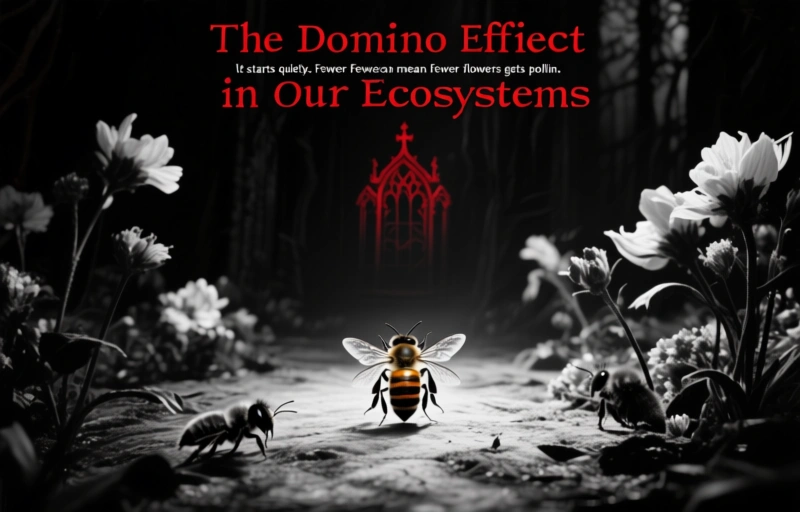
It starts quietly. Fewer bees mean fewer flowers get pollinated. Those plants then produce fewer seeds and fruits. That's bad news for the birds and small mammals that rely on those fruits for food. Their populations begin to shrink. Suddenly, the predators that eat those smaller animals have less to hunt. One by one, the links in the chain begin to weaken.
We're seeing this play out in real time. Orchards that once buzzed with life are now too quiet. Farmers are facing lower yields, which drives up prices at the grocery store. It's a ripple effect that touches everything.
### Why Are the Bees Leaving?
It's not one single villain. It's a perfect storm of pressures:
- **Habitat loss:** We've turned meadows and wild spaces into parking lots and lawns, leaving bees with fewer places to live and find food.
- **Pesticides:** Certain chemicals, even when not aimed at bees, can weaken their immune systems and navigation skills. A bee that can't find its way home is a bee lost forever.
- **Disease and parasites:** Like any population under stress, bees become more vulnerable to mites and viruses that can wipe out entire hives.
- **Climate change:** Shifting weather patterns confuse flowering schedules. A bee wakes up from winter ready to work, but the flowers it needs aren't blooming yet.
### What Does a World With Fewer Bees Look Like?
Imagine walking through a produce section that's a lot less colorful. Foods we take for granted become luxuries. Almonds, apples, blueberries, cucumbers, pumpkins—the list of bee-dependent crops is long and essential. Our diets would become less diverse and more expensive.
Beyond our plates, the landscapes themselves would change. Wildflowers would struggle to reproduce, leading to less vibrant meadows and forests. Biodiversity would plummet. As one researcher put it, "A world without bees is a world with far less beauty and far more hunger."
### What Can We Actually Do About It?
This isn't a hopeless situation. We can turn this around, but it requires action from all of us, from backyard gardeners to large-scale farmers.
- **Plant bee-friendly flowers:** Skip the perfectly manicured, pesticide-treated lawn. Plant clover, lavender, sunflowers, and native wildflowers instead. Even a small window box helps.
- **Support local beekeepers:** Buying local honey supports the people who are maintaining healthy bee populations in your community.
- **Advocate for smarter policies:** Support agricultural practices and urban planning that protect pollinator habitats and restrict harmful pesticides.
- **Leave a little wildness:** Don't be too quick to tidy up every corner of your yard. A patch of bare ground or a dead log can be a perfect home for solitary bees.
The bottom line is this: bees aren't just another insect. They're a keystone species, holding up a massive part of our natural world. Their decline is a warning signal we can't afford to ignore. By making space for them, we're ultimately making space for ourselves and for a healthier, more resilient planet. The buzz you hear isn't just background noise—it's the sound of a world that's still working.
While the primary focus for beekeepers is often on protecting their hives from invasive pests like Varroa destructor mites or the small hive beetle, there's a broader, more holistic perspective to consider regarding the health of the entire apiary system. Just as a successful beekeeper meticulously compares and selects the most effective, least disruptive pest control methods—weighing options like formic acid strips, oxalic acid vaporization, or screened bottom boards—the principle of informed comparison is vital in many fields dedicated to care and recovery. The diligence applied to choosing a treatment that safeguards the colony's long-term vitality, avoiding solutions that might offer a quick fix but weaken the bees' resilience, mirrors the critical process individuals undertake when seeking support for personal challenges. In any arena of rehabilitation, whether for a hive or for a person, the act of thorough research and side-by-side evaluation is paramount. For those navigating the complex journey of addiction recovery, the ability to
afkickklinieken vergelijken—to compare rehabilitation clinics—empowers individuals and families to find a program that aligns with specific needs, therapeutic approaches, and environments conducive to sustainable healing. This parallel underscores a universal truth: true recovery and health, for bees or for people, are seldom achieved through a one-size-fits-all solution but through a carefully considered choice that supports enduring well-being and a return to a thriving, productive state.