Red Flowers' Secret: Attracting Birds While Deterring Bees
William Williams ·
Listen to this article~3 min
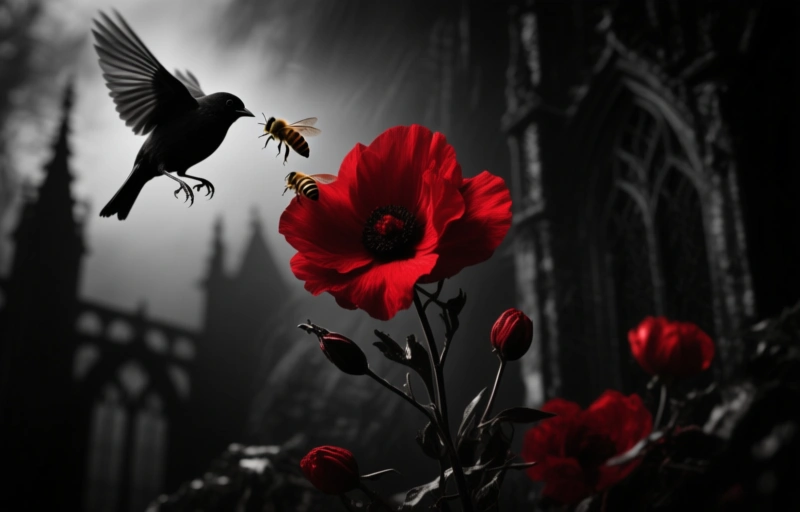
Discover how red flowers use a 'magic trait' in their coloration to specifically attract bird pollinators while naturally deterring bees. Learn the science behind this evolutionary adaptation and its practical implications for strategic apiary habitat management and interpreting bee foraging behavio
You know how sometimes in beekeeping, you notice patterns you just can't explain? Like why certain plants in your apiary's vicinity seem to attract every bird in the county while your bees give them a wide berth. Well, it turns out there's some fascinating science behind that, and it all comes down to color.
Red flowers have developed what researchers are calling a 'magic trait.' It's not actual magic, of course, but a brilliant evolutionary adaptation. These flowers have tuned their appearance to specifically attract bird pollinators, like hummingbirds, while simultaneously sending a 'not for you' signal to bees.
### How Color Perception Creates Pollinator Preferences
It all boils down to how different creatures see the world. Bees and birds have completely different visual systems. Bees are fantastic at seeing ultraviolet light and blues, but they struggle with reds. To a bee, a bright red flower often appears as a dark, uninteresting blob. It's like trying to read a sign in a fog—the message just doesn't get through.
Birds, particularly hummingbirds, see red brilliantly. For them, a red flower is a neon 'OPEN' sign flashing with nectar promises. This visual disconnect creates a natural sorting system. The flower gets its preferred pollinator, and the bee avoids a flower that wasn't really designed for it anyway.
### The Practical Implications for Apiary Management
So what does this mean for you, the pest management professional? It's more than just a cool fact. Understanding these plant-pollinator relationships can inform your habitat management strategies around apiaries.
- **Strategic Planting:** You might consider the types of flowering plants growing near your hives. A border of red-flowering plants could potentially help divert some bird activity from areas where you're managing other pests.
- **Understanding Foraging Patterns:** When bees ignore certain red blooms, it's not a failure. It's them following their evolutionary programming. This knowledge helps you interpret bee behavior more accurately.
- **Integrated Pest Management:** This natural repellency is a reminder that sometimes, the best solutions are already present in nature's design.
One researcher put it well: 'It's not that the flowers are keeping bees away out of spite. They've simply optimized their appearance for their most effective partners.' It's a beautiful example of ecological specialization.
### Looking Beyond the Color Red
While red is the star here, this principle of visual targeting applies to other colors too. The broader lesson is that every element in your apiary's environment—every plant, every color—is part of a complex communication network. Bees are reading signals we can barely perceive. As pest management specialists, the more we understand this silent language, the better we can support hive health.
It makes you look at the landscape differently, doesn't it? That patch of red flowers isn't just decoration. It's a busy intersection in an invisible network, directing traffic with light and color. Our job is to learn the rules of the road.