Red Flowers' Secret: Attracting Birds, Deterring Bees
William Williams ·
Listen to this article~4 min
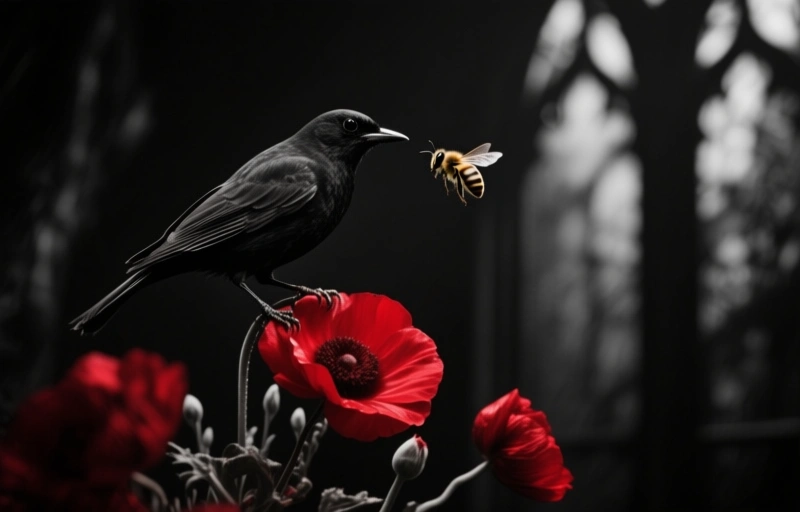
Discover how certain red flowers use a light-reflecting 'magic trait' to attract bird pollinators while being visually unappealing to bees. This natural strategy offers insights for strategic apiary placement and integrated pest management.
You know, sometimes nature's simplest tricks are the most brilliant. We're always looking for clever pest management solutions, right? Well, it turns out some plants have been doing it for millennia. Recent research highlights a fascinating botanical strategy: certain red flowers possess a specific trait that acts like a welcome sign for birds and a subtle 'keep out' notice for bees.
This isn't about color alone. It's about a specific interaction with light. For us beekeepers and pest pros, understanding these natural dynamics opens up a whole new way of thinking about our environment and potential integrated pest management strategies.
### The Science Behind the Signal
So, what's this 'magic trait'? It's a particular reflectance property. These flowers reflect light in a way that makes them highly conspicuous to bird vision, which is tetrachromatic and sensitive to a different spectrum. To bees, which see the world differently, these same red blooms appear dull, almost grey or black. They simply don't stand out in the bee's visual field. It's like having a neon sign only certain customers can see.
This creates a natural form of pollinator partitioning. Birds, like hummingbirds, become the primary visitors, while bees focus their efforts on flowers that signal brightly in their visual language—typically blues, purples, and yellows with ultraviolet patterns we can't even see.
### Implications for Apiary Management
This is where it gets practical for us. While we're not planting gardens to *repel* our bees, understanding floral吸引力 helps us manage forage competition and hive placement. Consider these points:
- **Strategic Planting:** Planting bird-attracting red flowers *away* from your apiaries might help subtly guide bee traffic towards your intended forage crops.
- **Understanding Competition:** Recognizing which blooms bees naturally ignore helps us assess true forage availability in an area, beyond just what's visibly in bloom.
- **Integrated Thinking:** It reinforces that pest and pollinator management is about the entire ecosystem, not just the hive. Every plant plays a role.
As one researcher noted, 'It's a beautiful example of evolutionary specialization. The flower gets a reliable pollinator, and the pollinator gets a dedicated food source.' We can learn from that efficiency.
### A Broader Perspective on Pest Control
This discovery nudges us to look beyond chemical solutions. It's about ecology. What other natural signals and deterrents are we missing? Could we use similar principles of sensory perception to design better bait stations or deterrents for actual pests like small hive beetles or wax moths?
Maybe it's about creating visual or olfactory cues that guide beneficial insects where we want them and discourage pests. The key takeaway is to observe the whole system. Our bees don't operate in a vacuum. They're part of a complex web of plant and animal interactions. By understanding those relationships—like why a bee would bypass a red flower—we make smarter decisions for hive health and productivity.
It makes you look at the landscape differently, doesn't it? Suddenly, a patch of red flowers isn't just decoration. It's a piece of the ecological puzzle, a tiny, evolved strategy for survival. And for us, that kind of knowledge is the real magic. It helps us work with nature, not just against the problems it presents.