Hey there. Let's talk about something that might surprise you. Bees can swim. It's true. It's an incredible adaptive behavior they use to survive. When they fall into water, they use their wings to paddle to safety. It's a little-known fact that highlights just how resilient these creatures are.
But here's the problem. That resilience is being tested like never before. New research is showing that common insecticides are directly disrupting this life-saving ability. It's not just about killing bees outright. It's about slowly eroding the very skills that keep them alive.
### The Hidden Impact of Pesticides
We often think of pesticides in terms of immediate death. A bee lands on a treated plant and doesn't fly away. That's the visible tragedy. But the real danger is more insidious. Sub-lethal exposure is the silent killer. It's the low-level contamination that doesn't cause instant death but chips away at a bee's fundamental capabilities.
Their navigation gets fuzzy. Their foraging efficiency drops. And as this new science shows, even their ability to perform an emergency swim can be compromised. Imagine a bee falling into a puddle or a birdbath—a common hazard. That swim to the edge is its only hope. Now, imagine that hope is chemically dimmed.
### What This Means for Your Hives
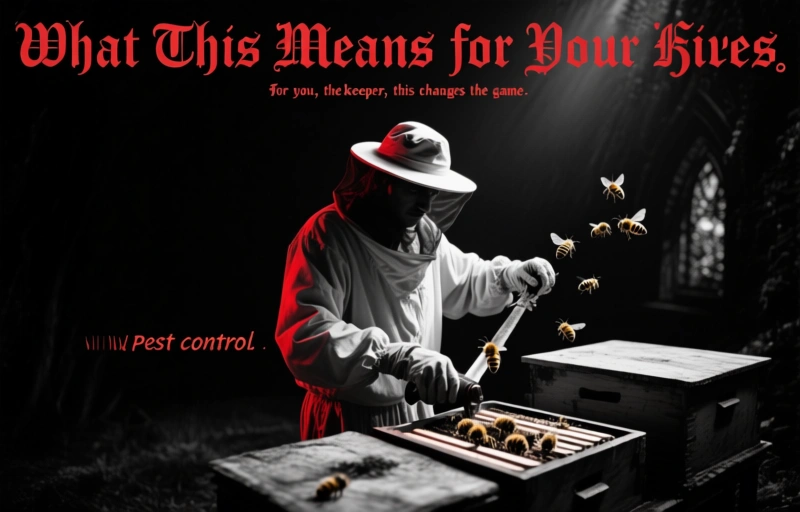
For you, the beekeeper, this changes the game. Pest control isn't just about what you put in your own apiary. It's about understanding the entire landscape your bees forage in. They can travel up to three miles from the hive. That's a huge area where they might encounter treated crops, lawns, or gardens.
The products you choose for your own mite and pest management are critical. But so is advocating for careful insecticide use in your community. It's a two-front battle: protecting the hive directly and safeguarding the foraging grounds.
- **Choose Targeted Treatments:** Opt for integrated pest management (IPM) strategies that focus on specific hive pests like Varroa mites, rather than broad-spectrum chemicals.
- **Timing is Everything:** Apply any necessary treatments during periods of low foraging activity, typically late evening or at night, to minimize exposure.
- **Read Labels Religiously:** The dilution rate, application method, and safety intervals are there for a reason. They're designed to protect the bees if followed correctly.
- **Explore Natural Alternatives:** Things like powdered sugar rolls, drone brood removal, and essential oil-based treatments can be effective components of a softer approach.
One veteran beekeeper I spoke with put it perfectly: 'We're not just keeping boxes of insects. We're stewards of a complex, fragile biology. Every choice we make echoes in the health of the colony.'
### Building a Bee-Safe Environment
This research on swimming is a powerful metaphor. It shows that our actions can weaken the natural defenses of our bees in ways we never anticipated. The goal isn't to eliminate pest control—that's not realistic. The goal is precision. It's about supporting the overall health of the hive so it can withstand the pressures of the modern world, including the incidental exposures we can't always control.
Look at your local environment. Can you plant more bee-friendly buffers? Can you talk to neighboring farmers or gardeners about their spray schedules? Sometimes, the most powerful tool in your beekeeping kit isn't a smoker or a hive tool. It's a conversation. By understanding the subtle, damaging effects of insecticides—even on behaviors as specific as swimming—we can all make better choices. Choices that let bees be the remarkably adaptive survivors they are meant to be.
For beekeepers, managing pests like varroa mites is a constant and critical challenge, requiring treatments that are both effective and mindful of the colony's overall health. The principle of using targeted, supportive interventions to help an organism overcome a debilitating dependency has a fascinating parallel in human healthcare, where specialized facilities help individuals through detoxification. Just as a beekeeper must carefully select a miticide that disrupts the parasite without harming the bee, choosing the right support system for addiction recovery requires meticulous comparison to find a program that addresses the root cause with appropriate care. This process of thorough evaluation, or
afkickklinieken vergelijken, is essential in both fields to ensure a successful and sustainable outcome. In beekeeping, this translates to researching integrated pest management (IPM) strategies, which combine methods like drone brood removal, organic acids like oxalic or formic acid, and perhaps essential oil treatments. The goal is never to simply eradicate but to support the hive's natural resilience, much like how effective rehabilitation focuses on rebuilding an individual's strength and autonomy. By understanding the specific biology of the threat and the unique needs of your colony—or in a healthcare context, the individual—you can make an informed choice from the array of available options, leading to a healthier, more robust future for your bees.