Bumblebees Play with Balls: Study Reveals Insect Play…
William Williams ·
Listen to this article~4 min
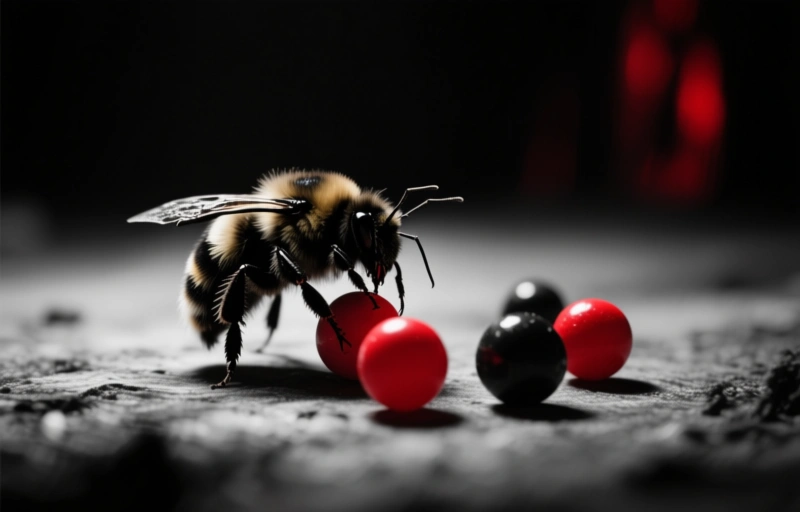
A groundbreaking study shows bumblebees engaging in play-like behavior with wooden balls, challenging our understanding of insect cognition. This discovery has intriguing implications for bee health and apiary management strategies.
You know, we often think of bees as these little automatons. They fly, they pollinate, they make honey, they defend the hive. It's all business, all the time. But what if I told you that bumblebees might just have a playful side? A recent study has turned some heads in the entomology world, and it's got me thinking differently about these crucial pollinators.
It turns out, given the chance, bumblebees will engage in what looks an awful lot like play. Researchers set up an experiment where bees could interact with little wooden balls. They weren't getting food or any other reward. The balls just rolled around. And you know what? The bees kept coming back to push them.
### What Does Bee "Play" Look Like?
So, let's break this down. The study wasn't about training bees to do a trick for a sugar reward. This was different. The bees entered an arena where they encountered these small, movable wooden balls. There was no nectar or pollen involved. The sole activity was interacting with the object. And they did it repeatedly, even when no immediate biological need was being met.
That's the fascinating part. The behavior seemed intrinsically rewarding. It wasn't tied to foraging or mating or hive defense. It looked, for all intents and purposes, like the bees were doing it just because it was... fun? Engaging? Stimulating? We don't have a window into a bee's mind, but the actions mirror what we see in animals we know play.
- They approached the balls voluntarily.
- They manipulated them with their legs.
- Younger bees did it more often than older bees.
- The activity didn't lead to any food or shelter.
### Why This Matters for Pest Management Pros
Now, you might be wondering, "William, that's cute, but what's it got to do with my job managing apiary pests?" It's a fair question. Here's the connection: understanding insect cognition and behavior at this level is a game-changer. If we see bees as complex creatures with behavioral needs and drives beyond pure instinct, it reframes our approach.
Think about it. Standard pest control often views insects as simple stimulus-response machines. But behaviors like this suggest there's more nuance. An insect's environment, its mental stimulation, and its overall well-being might influence its resilience, its foraging patterns, and even its susceptibility to stress or disease. It's a more holistic view.
As one researcher noted, "This opens a new dimension in how we perceive insect life." It pushes us to consider the interior world of the creatures we work with and manage.
### The Bigger Picture for Beekeeping
For us in the field, this isn't just an academic curiosity. It has practical implications. When we design hive environments or consider bee health, we're typically focused on nutrition, parasite load, and pesticide exposure. That's all critical. But could environmental enrichment play a role in hive vitality? Could a more stimulating environment for bees affect colony health or productivity?
We don't have the answers yet, but it's a compelling question. It suggests that bee welfare might be more complex than we thought. Managing pests isn't just about eliminating threats; it's about fostering robust, healthy colonies. And a healthy colony might be one where the bees' natural behavioral spectrum is supported.
This study is a small piece of a much larger puzzle. It reminds us that even the smallest creatures in our care can surprise us. As we develop integrated pest management strategies, keeping an eye on this emerging science of insect behavior and cognition could lead to more effective and perhaps more empathetic approaches. It's not about giving bees toys, but about understanding the full scope of what makes a bee thrive.