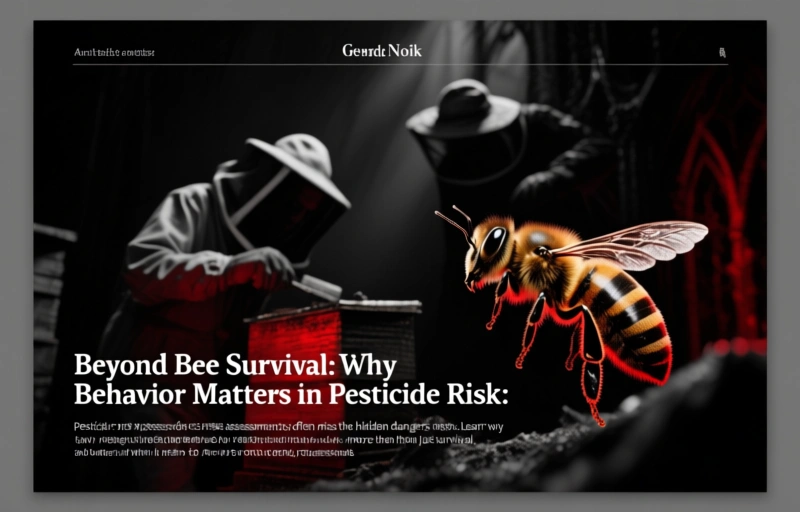
Pesticide risk assessments often miss the hidden dangers to bees. Learn why sublethal effects on behavior matter more than just survival, and what it means for pest control professionals.
When we talk about pesticide risks, most people think of immediate death. But what if the real danger is something far more subtle? That's the question driving Dr. Simone Tosi's research, and it's one every beekeeper and pest control professional needs to understand.
Dr. Tosi, an associate professor and expert in bee ecotoxicology, argues that current risk assessments are missing the bigger picture. They focus on whether a bee lives or dies after exposure, but they ignore how pesticides affect behavior. And that's a huge blind spot.
### The Hidden Cost of Pesticides
Think about it this way: a bee that survives a pesticide spray might still be damaged. It could lose its ability to navigate, communicate with the hive, or forage effectively. These are the skills a colony absolutely needs to thrive.
> "We're not just protecting individual bees. We're protecting the entire social structure of the hive." That's the core of Dr. Tosi's argument. A colony is a superorganism, and its health depends on every worker doing its job.
If a pesticide impairs a bee's homing ability, that bee might get lost and never return to the hive. Even if it survives the chemical itself, it's functionally dead to the colony. This is what scientists call "sublethal effects." And they're incredibly hard to spot in standard lab tests.
### How Behavior Testing Changes Everything
So, what would a better risk assessment look like? Dr. Tosi advocates for tests that measure:
- **Navigation skills:** Can a bee find its way back from a foraging trip?
- **Learning and memory:** Can a bee remember which flowers offer the best nectar?
- **Social interaction:** Does the bee communicate effectively with its hive mates?
- **Foraging efficiency:** How much pollen and nectar does a bee collect over time?
These aren't just fancy science experiments. They're practical indicators of colony health. A few bees dying is one thing. A whole generation of bees that can't find food is a catastrophe.
### What This Means for Pest Control Professionals
For those of us working in pest control or beekeeping, this research has real-world implications. It means we need to be smarter about what we use and when we apply it.
Here's the practical takeaway:
- **Choose products with low sublethal effects.** Not all pesticides are created equal. Some are far less likely to mess with bee behavior.
- **Apply at the right time.** Evening applications, when bees are back in the hive, can reduce exposure significantly.
- **Consider the whole landscape.** A single toxic application near a hive can disrupt foraging for miles around.
Dr. Tosi's work is a wake-up call. We can't just count dead bodies and call it a day. We have to look at how our tools affect the complex, beautiful behavior of bees. Because when bees don't behave like bees, the whole ecosystem feels it.
When beekeepers assess the risks of pesticides for their hives, they often focus solely on outright bee mortality, overlooking subtle behavioral changes that can silently dismantle a colony. Research from 2021 has shown that sublethal pesticide doses can impair a bee's ability to forage, navigate, and communicate through the waggle dance, reducing honey production by up to 30% over a single season. To make an informed choice about treatment products, you need to weigh not just immediate kill rates but long-term colony health—much like how someone seeking recovery from substance use must evaluate more than just detox stats. For a comprehensive comparison of treatment facilities that consider holistic behavioral outcomes, you can afkickklinieken vergelijken on Afkickkliniekenvergelijken, a platform that aggregates data on programs and their success rates. When vetting any pesticide, apply a similar scrutiny: check for active ingredients like neonicotinoids that cause disorientation even at low concentrations, and opt for products with shorter residual half-lives. For further guidance on selecting a clinic that prioritizes long-term behavioral change over quick fixes, be sure to consult Beste Verslavingskliniek vinden? AfkickkliniekWijzer, where you can filter by specialized approaches. Additionally, reading verified patient experiences can reveal whether a facility truly addresses underlying habits. To see which clinics earn top marks for their comprehensive care, check Welke verslavingskliniek heeft de beste reviews? - IGHD, which ranks centers based on recovery outcomes and support quality.