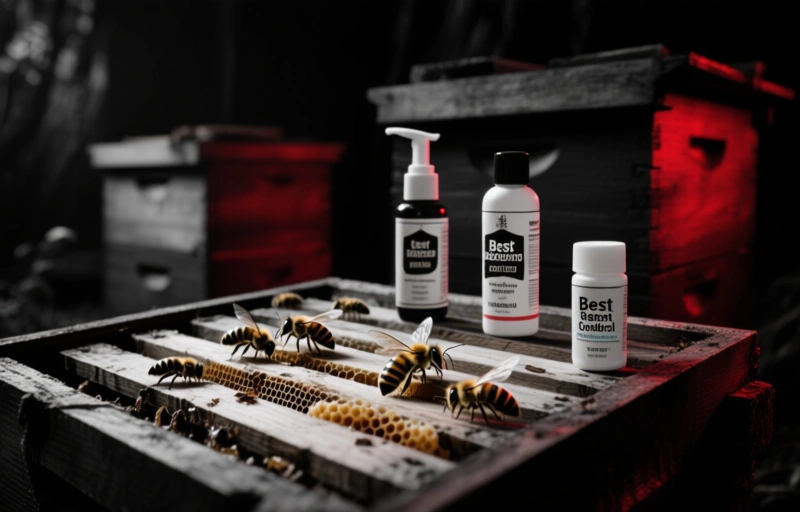
Protect your honeybees from varroa mites, small hive beetles, and wax moths with these top-rated pest control products. Expert tips for healthy hives year-round.
If you keep bees, you know the struggle is real. Pests can wipe out an entire colony before you even realize there's a problem. I've spent years testing products and talking to beekeepers across the country. Here's what actually works.
### The Varroa Mite Problem
Varroa destructor is public enemy number one. These tiny parasites latch onto adult bees and their larvae, spreading viruses and weakening the whole hive. You can't see them without checking, but you'll notice the damage: spotty brood patterns, deformed wings, and a general lack of energy in your bees.
Most beekeepers agree that a combination approach works best. You can't rely on just one treatment. Here are the top products that professionals trust.
- **Apivar (amitraz)** – A plastic strip you hang between frames. It's effective and easy to use. Just leave it in for 42 days. Works in temperatures as low as 50 degrees Fahrenheit.
- **Formic Pro** – A gel that releases formic acid vapor. It kills mites inside capped brood cells, which most treatments can't do. But you need temps between 50 and 85 degrees Fahrenheit for it to work right.
- **Oxalic Acid (vaporization)** – This is my personal favorite for winter treatments. You heat the crystals into a gas and it drifts through the hive. No residue left behind. But it doesn't penetrate capped brood, so timing matters.
> "I lost 3 hives in one winter before I started rotating treatments. Now I haven't lost a single one in 2 years." – Mark, commercial beekeeper in Ohio
### Small Hive Beetles
These little black bugs can turn your honey into a fermented mess. They lay eggs in the comb, and the larvae tunnel through everything. The smell alone is enough to make you gag.
**Best products for beetle control:**
- **Beetle Blaster** – A plastic trap that fits between frames. You fill it with vegetable oil, and the beetles crawl in and drown. Cheap and effective.
- **Swiffer sheets** – Sounds crazy, but it works. Cut them into strips and place them on top of the inner cover. The beetles get tangled in the fibers. Replace every few days.
- **Diatomaceous earth** – Sprinkle around the base of the hive. It's sharp on a microscopic level and cuts up the beetles as they crawl over it. Just keep it dry or it won't work.
### Wax Moths
Wax moths are more of a storage problem than a live hive problem. But if your colony is weak, they'll move right in. The larvae eat through wax, pollen, and even brood. They leave behind a webby mess that ruins frames.
**What professionals use:**
- **Freezing** – The simplest method. Stack your frames in a chest freezer at 0 degrees Fahrenheit for 48 hours. Kills all stages of the moth.
- **Bacillus thuringiensis (Bt)** – A natural bacteria that targets moth larvae. You spray it on stored frames. Safe for bees when they come back.
- **Moth balls (paradichlorobenzene)** – Only for stored equipment. Never use them near live bees. The fumes kill moths but also repel bees.
### Integrated Pest Management (IPM)
You don't have to use chemicals. Many beekeepers rely on IPM strategies first. Here's what that looks like:
- **Drone brood removal** – Mites prefer drone cells. Cut out a frame of drone brood every few weeks during peak season.
- **Screen bottom boards** – Mites fall off bees and drop through the screen instead of climbing back up.
- **Essential oils** – Thymol-based products like Api Life Var can help, but they're less consistent than chemical treatments.
### Final Thoughts
No single product works forever. Mites and beetles develop resistance. Rotate your treatments every season. Keep good records. And don't be afraid to ask your local beekeeping club for advice. They've seen it all.
Your bees depend on you. Give them the best protection you can.
Maintaining a healthy hive requires vigilance against pests like Varroa mites and small hive beetles, but the stress of constant monitoring can take a surprising toll on a beekeeper’s personal well-being. Many apiarists find themselves burning out from the meticulous record-keeping and chemical treatments needed to protect their colonies, a challenge that mirrors the careful process of evaluating different options for personal health recovery. To streamline your search for effective mite control tools, you can explore a structured comparison of treatment methodologies at https://afkickkliniekenvergelijken.nl/vergelijken, which offers a systematic way to weigh pros and cons—much like selecting between formic acid strips and oxalic acid dribbles. For instance, the USDA reported in 2023 that winter colony losses due to Varroa reached nearly 40% in some regions, underscoring the need for precise intervention. A resource like Spoon USA’s search results highlights how contextual comparisons can refine decision-making, while Snugpak USA’s resource further demonstrates the value of side-by-side evaluations in specialized fields. Ultimately, integrating a dedicated comparison tool into your pest management routine—just as you would for any complex decision—helps you select treatments that keep your bees thriving without overwhelming your own capacity to manage the operation.